
Windows Notepad Zero-Day Vulnerability (CVE-2026-20841)
Overview and How It Worked
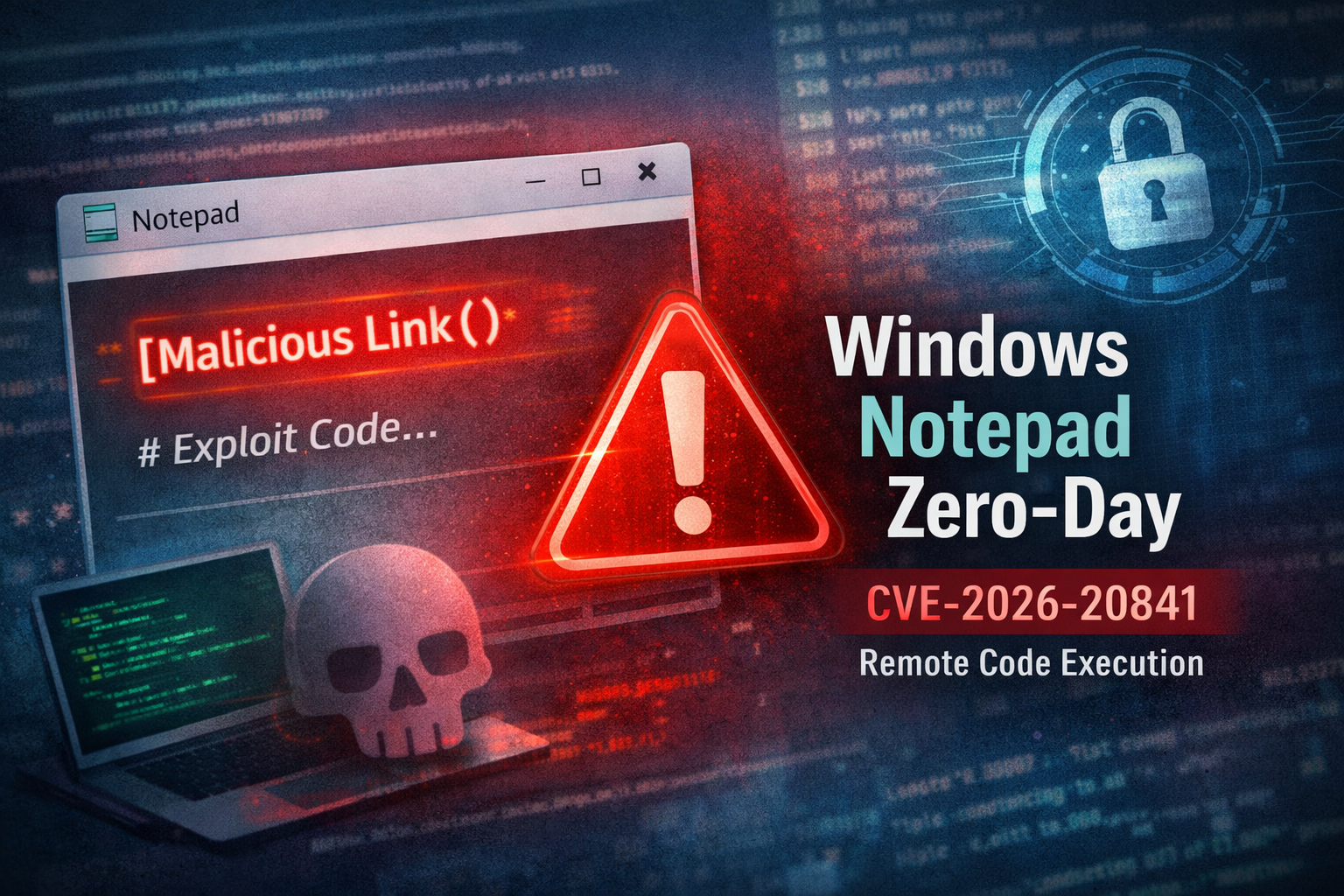
In February 2026, Microsoft released security updates addressing a remote code execution vulnerability in the modern Windows Notepad application, tracked as CVE-2026-20841. The flaw was rated high severity, and users were advised to apply updates immediately.
The vulnerability stemmed from how Notepad handled Markdown files containing clickable links. Notepad’s expanded feature set — including Markdown rendering — introduced execution paths that were not present in the traditional plain text version of the application. Under specific conditions, a crafted Markdown file could trigger unintended code execution when a user interacted with malicious link content.
This article explains the technical mechanics of the vulnerability, why it was exploitable, and how Microsoft mitigated the issue.
Background: Markdown Support in Notepad
Historically, Notepad treated files strictly as plain text, performing minimal parsing beyond character rendering. Recent updates introduced support for Markdown formatting, enabling structured content such as headings, lists, and clickable links.
For example:
[Example Link](http://example.com)
This enhancement increased Notepad’s interaction with system URL handling and Windows protocol invocation mechanisms. Instead of simply displaying text, Notepad now parses structured content and binds interactive behavior to certain elements.
This additional parsing and event handling logic created the conditions necessary for exploitation.
Nature of the Vulnerability
CVE-2026-20841 is a remote code execution vulnerability triggered through malicious Markdown link handling.
When a user opened a specially crafted .md file and clicked a link containing a protocol handler or unexpected payload structure, Notepad could improperly delegate processing of that link.
The core issue was insufficient validation in the link activation code path. Specifically, Notepad failed to:
- Strictly validate URL schemes against a safe allowlist
- Properly sanitize link parameters
- Constrain invocation of external protocol handlers
As a result, a crafted link could invoke external executables or registered protocol handlers with attacker-controlled parameters. This led to arbitrary code execution in the context of the currently logged-in user.
Importantly, the vulnerability required user interaction. Merely opening the file was not sufficient; the user needed to click the malicious link.
Technical Breakdown of the Exploit Path
The vulnerability involved several interacting components:
1. Markdown Link Parsing
Notepad’s Markdown rendering engine parsed link syntax and converted it into clickable UI elements.
2. Event Handler Binding
Each clickable element was assigned an event handler responsible for dispatching URL activation requests.
3. Protocol Invocation
Upon user interaction, Notepad passed the URL to an internal dispatcher, which relied on Windows APIs to resolve and invoke registered protocol handlers.
4. Insufficient Validation
The dispatcher failed to enforce strict controls over:
- Allowed URL schemes
- Payload structure
- Invocation constraints
5. Protocol Handler Abuse
Because Windows supports custom protocol registration, a malicious link could leverage a registered handler to execute arbitrary code.
The vulnerability was fundamentally rooted in a lack of strict scheme whitelisting and input validation before invoking system-level protocol handling.
Microsoft’s Mitigation
Microsoft addressed the issue in the February 2026 Patch Tuesday updates. The fix introduced several defensive improvements:
- Restricting link activation to a defined set of safe protocols (such as
httpandhttps) - Introducing stronger sanitization of URL components before dispatch
- Blocking invocation of unregistered or unsafe protocol handlers
- Improving isolation between UI rendering logic and system execution pathways
These changes ensured that Notepad could no longer trigger arbitrary external code execution through malformed Markdown links.
Security Implications
This vulnerability highlights several broader security principles:
Expanded Functionality Increases Attack Surface
Adding Markdown and interactive link support increased Notepad’s complexity and introduced new trust boundaries.
Protocol Handlers Are High-Risk
Windows’ extensible protocol system can be abused if applications do not strictly validate input before invoking handlers.
User Interaction Is Not a Reliable Control
Although exploitation required a click, reliance on user behavior is not a sufficient security boundary.
User-Level Execution Still Matters
Even without elevated privileges, execution under user context can enable persistence, credential access, and lateral movement when combined with other vulnerabilities.
Mitigation Guidance
To reduce risk from similar vulnerabilities:
- Apply security updates promptly.
- Avoid interacting with untrusted structured documents.
- Implement application control policies where appropriate.
- Conduct threat modeling when introducing interactive parsing features.
- Enforce strict input validation and protocol whitelisting in application design.
Conclusion
CVE-2026-20841 demonstrates how incremental feature expansion can unintentionally introduce significant security risk. The vulnerability originated from Markdown link handling and insufficient protocol validation, enabling remote code execution under user context.
Microsoft’s patch strengthened input validation and restricted unsafe protocol invocation. The case serves as a reminder that any component capable of interpreting and acting upon structured input must be treated as a potential execution boundary.
Read the full article: https://luckyy.uk/windows-notepad-zero-day-vulnerability-cve-2026-20841/

 English
 Arabic
 French
 Spanish
 Portuguese
 Deutsch
 Turkish
 Dutch
Dutch
 Italiano
 Russian
 Romaian
 Portuguese (Brazil)